StoryForge Library
Amazon KDP AI Disclosure for Fiction Authors
A practical guide to Amazon KDP AI disclosure for fiction authors, including what counts as AI-generated, what counts as AI-assisted, and how to answer the question without guessing.
If you are searching for Amazon KDP AI disclosure, you probably do not want a philosophy debate. You want to know what to click when KDP asks whether your book contains AI-generated content, and you want to avoid making a dumb mistake on a book you spent months building.
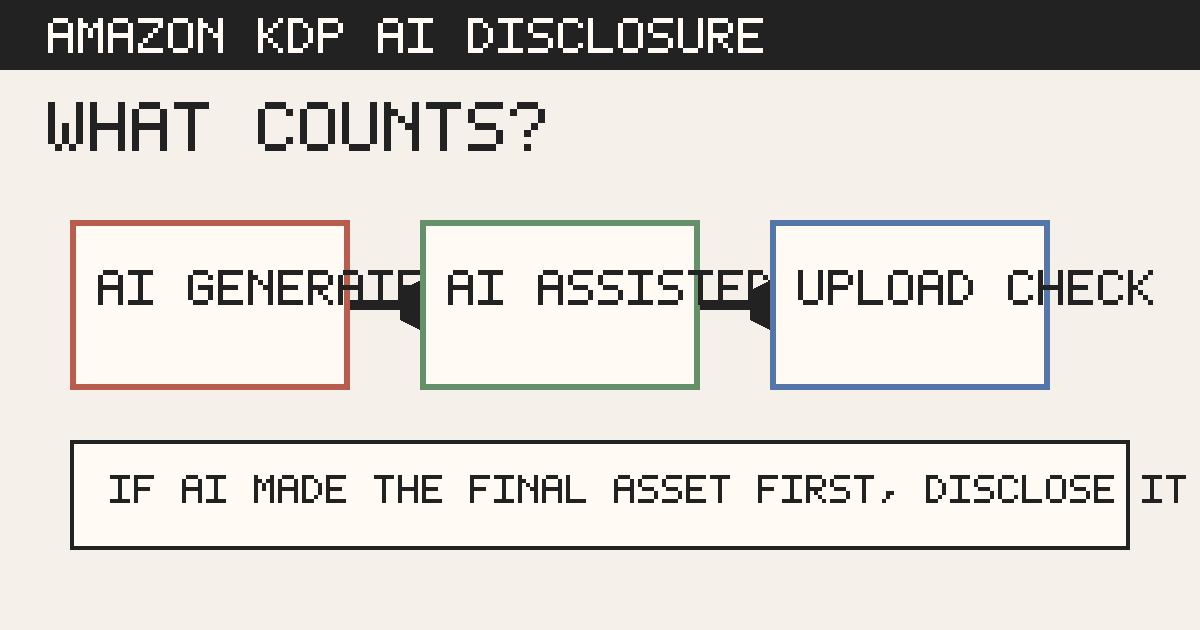
Here is the practical answer for fiction authors in 2026: Amazon KDP wants disclosure when the final content in the book was generated by AI. It does not require disclosure when you created the content yourself and only used AI to brainstorm, edit, refine, or error-check it.
That sounds simple until you are deep in a real novel workflow.
What Amazon KDP actually says
Amazon's own KDP Content Guidelines draw a clear line.
KDP says authors must inform Amazon about AI-generated content when publishing or republishing through KDP. The same guideline says you do not need to disclose AI-assisted content.
The important part is how Amazon defines those terms.
According to the KDP page, AI-generated content is text, images, or translations created by an AI-based tool. KDP also says it still counts as AI-generated even if you substantially edit it afterward.
By contrast, KDP treats content as AI-assisted when you created the content yourself and used AI tools to edit, refine, error-check, improve, or brainstorm around that content.
That distinction is the whole game.
The fiction-author version of the rule
If the prose that appears in your final novel came out of ChatGPT, Claude, Sudowrite, NovelCrafter, or another AI system as drafted text, that is the safer side of the line to treat as AI-generated for KDP disclosure.
If you wrote the prose yourself and used AI to punch up a sentence, test alternate wording, summarize your own outline, or clean grammar, that is closer to AI-assisted.
If an AI tool made the cover image or interior art that ships with the book, that is also part of the disclosure question.
This is why the search intent around KDP disclosure is not really about the checkbox. It is about process clarity.
Authors are trying to answer questions like:
- Does rewritten AI prose still count as AI-generated?
- Does outlining with AI count?
- Does editing with AI count?
- What about cover art?
- What if I used AI in one chapter but not the whole book?
The KDP guideline gives a workable answer, but only if your workflow is organized enough to know what happened.
Where authors get confused
The confusion usually comes from mixing three different writing patterns together.
1. AI drafted the book
You prompted a model for scenes, chapters, chunks of dialogue, or whole chapters, then revised what it gave you.
This is the easiest case. The final book contains AI-generated text. Treat it that way.
2. You drafted the book and AI helped polish it
You wrote the manuscript, then used AI for line edits, grammar cleanup, awkward-sentence alternatives, synopsis brainstorming, or continuity questions.
This is much closer to AI-assisted use.
3. The workflow kept switching back and forth
This is where people get nervous. You wrote some scenes. AI drafted some others. You rewrote a lot. Then you asked AI to generate back-cover copy, metadata, maybe even a map or cover concept.
That hybrid workflow is common, especially for indie fiction authors moving fast.
It is also why vague memory is not enough. If you cannot explain how the book was built, disclosure becomes guesswork.
A clean way to answer the KDP question
The easiest way to stay sane is to ask one blunt question about each asset in the final package:
Did I create this content first, with AI only helping improve it, or did AI create the content that I later revised?
Use that test for:
- manuscript prose
- cover art
- interior art
- translations
- bonus material that appears inside the book
If AI created the content first, do not play games with wording. That is the side of the line KDP describes as AI-generated.
If you created the content first and AI only helped refine it, that is the stronger case for AI-assisted.
This is not legal advice. It is the practical reading fiction authors can actually use when upload day arrives.
Why this matters more in fiction than people admit
A lot of generic KDP advice is written as if every book is a low-stakes content object. Fiction authors know better.
A novel is not just words on a page. It is continuity, voice, pacing, emotional logic, and genre promise. If your workflow is messy enough that you cannot tell what was authored by you versus generated by a model, that same mess usually shows up elsewhere too.
It shows up in drifting voice.
It shows up in scenes that repeat the same emotional beat.
It shows up in continuity errors you only notice when the book is nearly done.
Tom's Guide made a similar point in its January 2, 2026 article on why ChatGPT alone does not get most authors to the finish line. Once a project gets a few chapters deep, continuity starts breaking, plot threads vanish, and the burden shifts back to the author to repair the damage.
That is why disclosure and workflow belong in the same conversation.
The safer workflow for KDP fiction authors
1. Separate drafting from support work
Keep a clear line between content generation and content improvement.
If AI is drafting scenes, mark that mentally and operationally as generated content. If AI is helping you revise your own pages, treat that as support work.
When those two modes get blurred together in one endless chat, the disclosure question becomes harder than it needs to be.
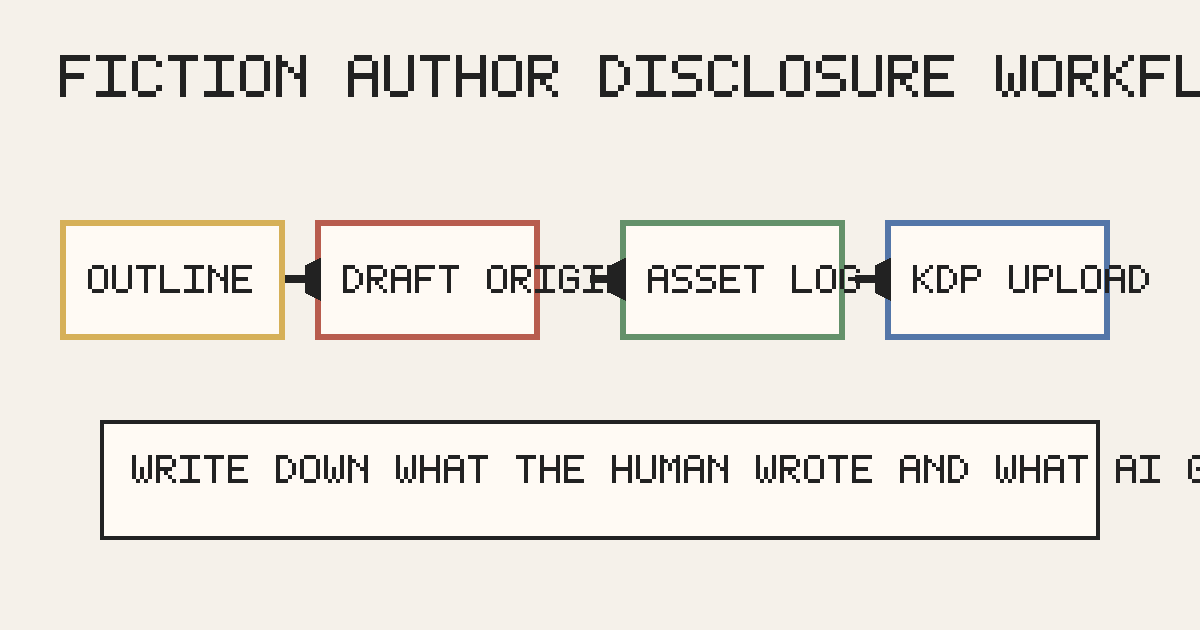
2. Track origin while the book is being built
Do not wait until upload day to reconstruct your process from memory.
Track the origin of final assets while you work.
That can be as simple as noting:
- human-written draft
- AI-drafted draft
- human-written cover brief, AI-generated cover concept
- human translation versus AI translation
You do not need courtroom paperwork. You need enough process memory to answer the KDP question honestly and quickly.
3. Treat AI-generated cover and interior art seriously
Some authors focus only on manuscript text and forget the visuals.
KDP's guideline explicitly includes images. If AI created the cover image or interior art that appears in the published file, that belongs in the same disclosure conversation.
4. Do not confuse revision effort with content origin
This is the trap that catches people.
Authors think, "I edited the AI output so much that it became mine."
Maybe the prose is absolutely better because of your revision. Maybe it is publishable only because you took it apart and rebuilt it.
KDP's wording still matters. The page says content created by an AI-based tool remains AI-generated even if substantial edits happen afterward. If the tool created the actual content first, your revision effort does not move it into the AI-assisted bucket.
5. Build the book so disclosure is boring
Boring is good here.
You want a workflow where KDP disclosure feels obvious, not stressful.
That usually means the same workflow discipline that also makes the book better: a real outline, stable voice rules, chapter-level continuity, and fewer mystery files scattered across random chats.
If you want the broader publishing-risk view, read Can You Publish an AI Book on Amazon KDP in 2026?. If your bigger problem is that the story workflow collapses before the book is done, Why AI novel workflows fall apart after chapter one and Why indie authors need a real novel outline are the more useful next reads.
My recommendation
Do not treat KDP disclosure as a branding problem.
Treat it as a process question.
If AI created final text, final images, or final translations that appear in the book, disclose that. If you created the work and AI only helped refine or brainstorm around it, that is the clearer case for AI-assisted use.
The more important lesson is upstream: your workflow should be organized enough that this answer is easy.
That is one reason StoryForge is built around a connected book-production path instead of a blank chat. Authors do not only need word generation. They need a system that carries decisions forward from outline through voice, draft, revision, and publish-readiness.
Disclosure
This article was researched from current live search intent and source pages on June 11, 2026, drafted with automation assistance, checked for external-link validity before publishing, and prepared through StoryForge's signed blog workflow. I used automation here because authors searching KDP disclosure need a current, source-backed answer fast, not recycled guesswork.
If you want a workflow that helps you keep draft origin, voice, continuity, and final-book quality in one place, start your free trial.
Ready to turn a book idea into a publish-ready manuscript?
Start your free trial