StoryForge Library
How to Use AI for Kindle Unlimited Books
A practical AI workflow for Kindle Unlimited authors who need speed, continuity, and clean KDP disclosure without publishing obvious AI slop.
If you are searching for how to use AI for Kindle Unlimited books, you are probably not asking whether AI can produce words. You are asking whether AI can help you ship faster without wrecking voice, continuity, or your KDP setup. That is a different question.
Kindle Unlimited rewards authors who can keep publishing, but KU readers still punish books that feel rushed, repetitive, or obviously machine-made. Amazon also expects you to follow both its KDP Select requirements and its KDP Content Guidelines for AI-generated content.
So the useful question is not, "Can AI write KU books?" It is, "What kind of AI workflow can actually survive a KU release schedule?"
The KU pressure is not just word count
Kindle Unlimited pushes authors toward consistency.
You need to release often enough that readers stay inside the series. You need characters to sound like themselves in book three. You need the world rules to survive the middle of the draft. You need blurbs, covers, and metadata to line up with the promise of the book. And if you enroll an ebook in KDP Select, Amazon's own requirements say that ebook has to stay exclusive to the Kindle Store for the 90 day enrollment period.
That means a KU workflow lives or dies on production discipline.
This is where a lot of generic AI writing advice breaks. Prompt-box demos are built to impress you in ten seconds. Kindle Unlimited punishes what happens thirty thousand words later.
What Amazon actually requires before you chase speed
Two Amazon rules matter here.
First, KDP says you must inform them when a book includes AI-generated text, images, or translations. Their help page also says you do not need to disclose AI-assisted content. That distinction matters for fiction authors because plenty of workflows mix both.
Second, KDP Select is not just a marketing toggle. Amazon states that the enrolled Kindle ebook must be exclusive to the Kindle Store during the enrollment period, while other formats can still be distributed elsewhere.
That gives you a simple baseline:
- If AI generated final text or final images that appear in the book, treat disclosure as a compliance step, not a branding debate.
- If your ebook is in KDP Select, build your workflow around Amazon exclusivity from day one instead of treating distribution like an afterthought.
- If your release plan depends on a series, assume continuity mistakes are more expensive than slower drafting.
This is also why the broad question in Can You Publish an AI Book on Amazon KDP in 2026? is only the start. KU authors need an operating system, not a yes or no.
Where generic AI breaks for KU authors
The first failure mode is voice drift.
A chat model can give you a decent opening chapter and still lose the tone by chapter six. That might be survivable in a hobby project. It is a disaster if your income depends on readers moving straight into book two.
The second failure mode is continuity sprawl.
Series fiction stacks hidden promises fast. Character injuries, power limits, family names, house rules, weapon details, romantic beats, villain motives, and trope timing all have to keep agreeing with each other. If you are writing fast, those details slip unless the workflow keeps them visible.
The third failure mode is false speed.
A lot of authors think they are saving time because the draft arrives faster. Then they lose the week in cleanup. They re-read for contradictions. They rewrite generic banter. They fix scene goals that vanished. They rebuild the outline after the book drifted off the market promise.
That is not high-speed production. That is just moving the pain later.
This is why Write a Book Series With AI Without Losing Continuity matters so much for KU authors. A series workflow has to keep the promises of earlier books alive while the next draft is still moving.
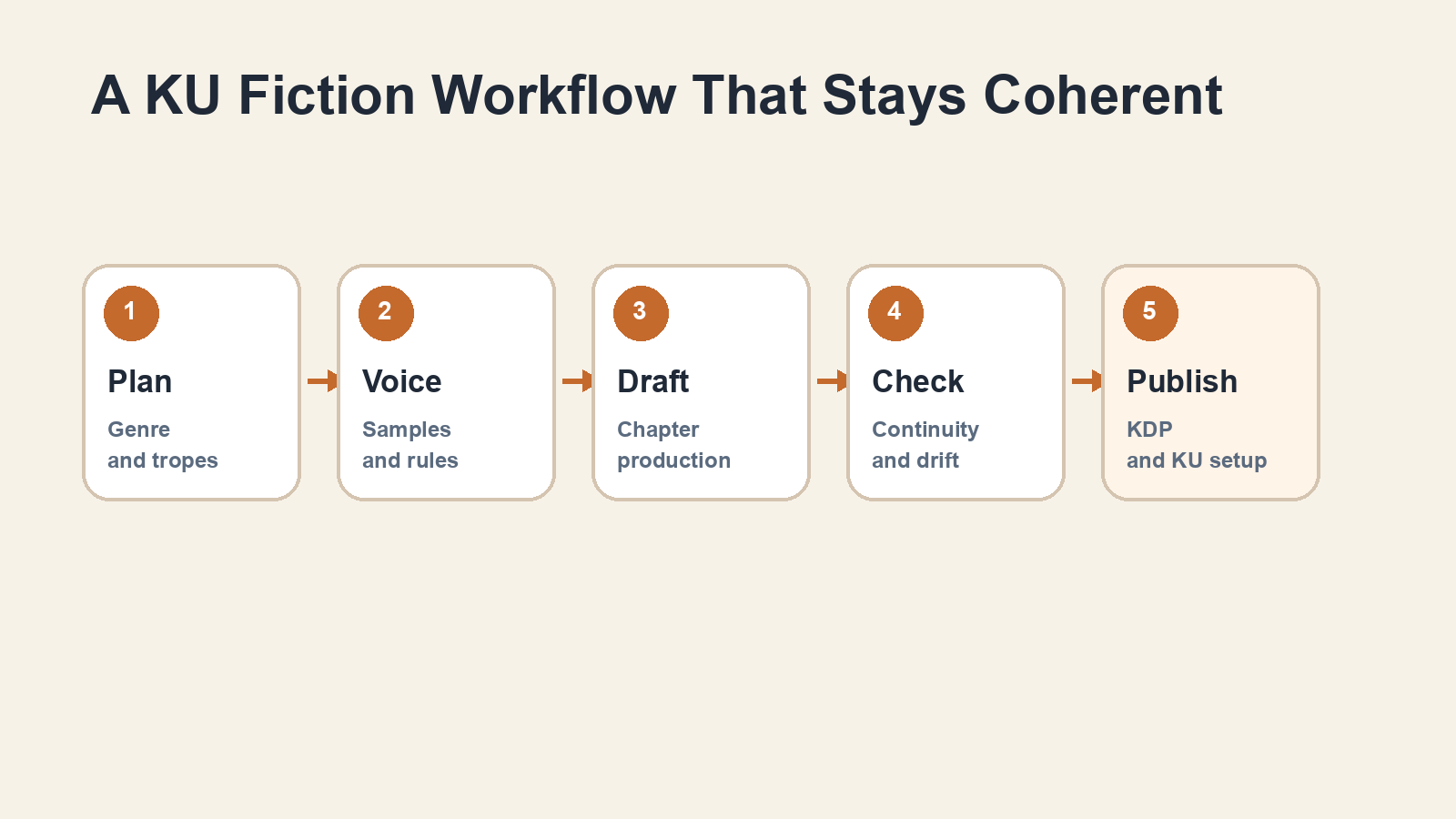
A practical AI workflow for Kindle Unlimited fiction
The workflow that makes sense for KU is boring in the right places.
1. Lock the market promise before drafting
Start with genre, reader promise, series arc, and trope expectations.
If you write romance, that means knowing the emotional payoff and heat lane before chapter one. If you write litRPG, it means knowing progression logic, class fantasy, and reward cadence. If you write cozy mystery, it means knowing the sleuth, the social world, and the reveal structure.
The AI should be serving that promise. It should not be inventing the product while you draft.
2. Separate AI-assisted work from AI-generated final content
This is the cleanest publishing habit you can build.
Brainstorming, outlining, scene diagnosis, continuity reminders, and editorial critique can all be AI-assisted without becoming the final content. Once the tool is generating the actual text or images that go into the book, you are in the AI-generated bucket Amazon describes in its content guidelines.
If you keep that distinction clear while drafting, KDP disclosure stops feeling confusing later.
3. Draft against a live series memory
Do not trust a single chat thread to remember your series.
The workflow needs a persistent record of character voice, unresolved plot threads, world rules, scene goals, and future payoffs. Otherwise the model will happily contradict book one while sounding confident.
This is the gap behind a lot of prompt-heavy stacks. You can see the same pattern in AI Novel Workflow From an Author Programmer: the hard part is not generating text. The hard part is keeping the book coherent while production continues.
4. Validate every chapter before you move on
For KU authors, chapter validation is cheaper than manuscript rescue.
Before you approve a chapter, check:
- Does the scene move the series promise forward?
- Does the voice still sound like the same author?
- Did any canon detail quietly change?
- Did the chapter introduce filler that will slow read-through?
- Does the ending create momentum into the next chapter?
That is how you protect cadence without publishing junk.
5. Build your KDP handoff at the same time as the draft
Do not wait until upload day to remember the business side.
Track whether the final manuscript or images are AI-generated under Amazon's definition. Keep your cover, front matter, back matter, and series metadata consistent. If the ebook is heading into KDP Select, make sure your distribution plan respects exclusivity before the preorder or launch window gets messy.
The authors who stay calm at publish time are usually the authors whose workflow made these decisions earlier.
When AI makes sense for KU, and when it does not
AI is useful for Kindle Unlimited authors when the bottleneck is production discipline.
It helps when you already know your lane, your readers, your series promise, and your standards, but you need help maintaining momentum across outlining, drafting, continuity, and cleanup.
It is a bad fit when you are hoping the model will figure out the market, the story, and the prose quality for you.
KU is too exposed for that. Readers are good at sniffing out filler. They do not care that the tool was fast. They care whether the book paid off.
That is also why broad tool roundups like Best AI Writing Tools for Authors in 2026 only get you part of the way. The better question is whether the workflow keeps quality intact while you keep shipping.
The decision rule I would use
If you are writing standalone literary work on a slow cadence, a generic AI assistant might be enough.
If you are writing genre fiction for Kindle Unlimited, especially in a series, I would optimize for workflow over raw generation. I would want:
- clear separation between AI-assisted work and AI-generated final content
- persistent voice and continuity memory
- chapter-level validation before drift compounds
- a clean KDP disclosure habit
- a production system that can repeat next month, not just this week
That is the difference between using AI as a shortcut and using it as infrastructure.
Automation note
I used AI to help structure and draft this article, then checked the live KDP source pages manually before publishing so the compliance details stayed anchored to the current Amazon help documentation. The point of the post is not to pretend AI was absent. The point is to show the exact workflow fiction authors need if they want speed without KU-grade slop.
One next step if this is your lane
If you want the version of this workflow that keeps outline, voice, continuity, drafting, and KDP-minded production in one system, start your free trial.
Ready to turn a book idea into a publish-ready manuscript?
Start your free trial